It Takes a Village (and a Group Chat): How Indian and Filipino Americans Are Keeping Chosen Family Alive
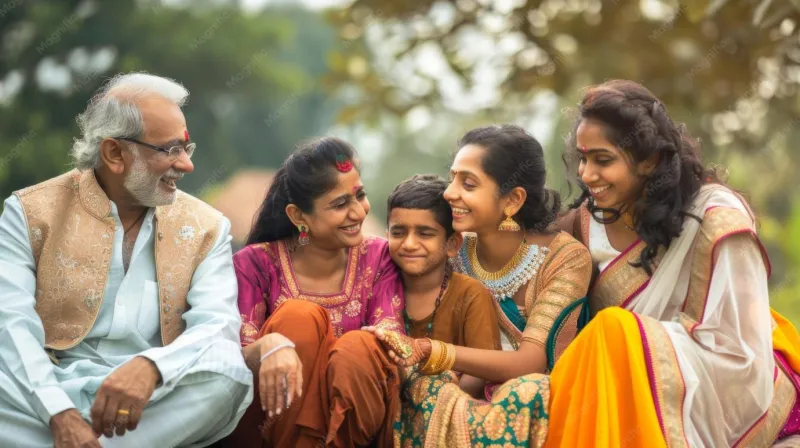
Photo: multigenerational Indian Filipino American family gathering celebration, via img.freepik.com
Somewhere in suburban New Jersey, a woman named Priya is picking up her neighbor's kids from school — not because she's paid to, not because she was guilted into it, but because she's Ninang to those kids. Godmother. The title comes with weight, history, and an unspoken agreement that stretches back generations.
Across town, a Filipino American couple just texted their kumpadre — their child's godfather — asking if he could co-sign a lease for their college-bound daughter. He said yes before they finished the sentence.
This is the godparent economy. And in Indian and Filipino American communities across the US, it's very much open for business.
What We're Actually Talking About
Western culture has godparents too, technically. But in many American families, the role has been reduced to showing up at a baptism and maybe sending a birthday card. In Indian and Filipino traditions, it means something fundamentally different.
In Filipino culture, the ninong (godfather) and ninang (godmother) are part of a broader compadrazgo system — a web of ritual co-parenthood that binds families together through ceremonies, obligations, and genuine emotional investment. A child might have a dozen godparents by the time they're ten. Each one is expected to actually show up: at graduations, during financial hardships, when someone needs a reference letter or a place to crash.
In many Indian communities, similar structures exist under different names. The concept of masi, mama, chacha, and chachi — terms for aunts and uncles that go well beyond blood relation — creates a layered support system where community members function as extended family whether or not they share DNA. Ceremonies like namakarana (naming rituals) or annaprashan (first feeding) formalize relationships between families in ways that carry real, lasting expectations.
Both traditions essentially do the same thing: they turn social bonds into infrastructure.
Why It Still Works in America
Immigration strips a lot away. Extended family stays behind. The neighborhood aunties aren't next door anymore. The village that raised you is suddenly 8,000 miles away and on a 12-hour time difference.
For Indian and Filipino Americans, the godparent model has become one of the most practical tools for rebuilding that village on American soil. And it's not just sentiment — it's survival strategy.
Think about what these networks actually provide. Childcare that doesn't cost $3,000 a month. A trusted adult who can help a teenager navigate college applications. Someone who'll lend money without charging interest or making you feel small. A safety net that doesn't require paperwork.
In communities where first-generation immigrants are often navigating systems that weren't designed for them — from credit scores to healthcare bureaucracy — having people who get it and will vouch for you is genuinely priceless.
"My ninong helped me get my first apartment when I had no credit history," says one Filipino American woman in Los Angeles. "He called the landlord personally. That's not something you can put a dollar value on."
The Group Chat Is the New Godparent Meeting
Here's where things get interesting. Younger Indian and Filipino Americans aren't abandoning these systems — they're upgrading them.
The traditional model was geographically bound. Your godparents lived nearby; they came to Sunday dinners; they were woven into your daily life. That's harder to replicate when your community is scattered across Atlanta, Seattle, Houston, and Queens.
So the workaround? Technology. WhatsApp groups. Discord servers. Private Facebook communities. These digital spaces are functioning like the old neighborhood in new form — places where someone can post "does anyone know a good immigration lawyer in Phoenix?" and get three referrals within the hour. Where a new mom can find another Filipino American parent willing to do a childcare swap. Where someone fresh off the plane can ask for restaurant recommendations and end up with a whole social circle.
Some communities are formalizing this even further. Indian American professional networks in cities like Chicago and San Francisco have created mentorship programs that explicitly echo the godparent model — pairing established professionals with newcomers in a relationship that's meant to be personal, not just transactional. Filipino American organizations are running similar programs, connecting younger members with elders who can offer guidance on everything from career moves to navigating family pressure.
Cross-Cultural Kinship: When the Village Gets Bigger
One of the more unexpected developments? Indian-Filipino families are creating blended versions of these traditions that draw from both cultures.
In households where one partner is Indian and the other is Filipino — a combination more common than most people realize, particularly in healthcare professions and major metro areas — the question of godparents becomes a genuinely creative exercise. Whose tradition leads? Both, it turns out.
Some families are choosing godparents from each side, creating a web of ninongs, ninанgs, and Indian equivalent figures who each bring something different to the table. The Filipino side might handle the ceremonial formalities; the Indian side might show up with home-cooked food for the first three months after a baby is born. Neither cancels the other out. They just make the net bigger.
This cross-pollination is showing up in how younger people think about chosen family more broadly. The idea that you can build your village — that kinship doesn't have to be purely biological or even culturally homogenous — feels deeply resonant for a generation that grew up between cultures.
Keeping It Real While Moving Forward
None of this is without tension. The obligations that make these networks powerful can also feel like pressure. Godparents in Filipino tradition are sometimes expected to contribute financially to weddings, graduations, and major milestones — a tradition that's beautiful in theory but can get complicated when people are managing their own financial stress.
In Indian communities, the expectation of reciprocity — you help me, I help you, and we both remember — can occasionally tip into transactional territory that feels at odds with the spirit of the thing.
Younger generations are navigating this honestly. They want the warmth and the safety net, but they're also setting boundaries, having direct conversations about expectations, and building networks that feel sustainable rather than obligatory.
The goal isn't to replicate the old village exactly. It's to take what worked — the trust, the showing up, the genuine investment in each other's wellbeing — and make it work in a country that wasn't built with this kind of community in mind.
The Village Is Still Here
At its core, the godparent economy is about a simple bet: that people who care about each other can create more stability together than any of them could alone. Indian and Filipino Americans have been making that bet for generations, across oceans and time zones and cultural shifts.
The group chats are full. The ninongs are still picking up the phone. And somewhere in New Jersey, Priya is probably already on her way to pick up those kids.
The village didn't disappear. It just got a new zip code.