Mom's Kitchen, Two Continents: How Indian and Filipino Families Are Raising Kids Who Cook from the Heart
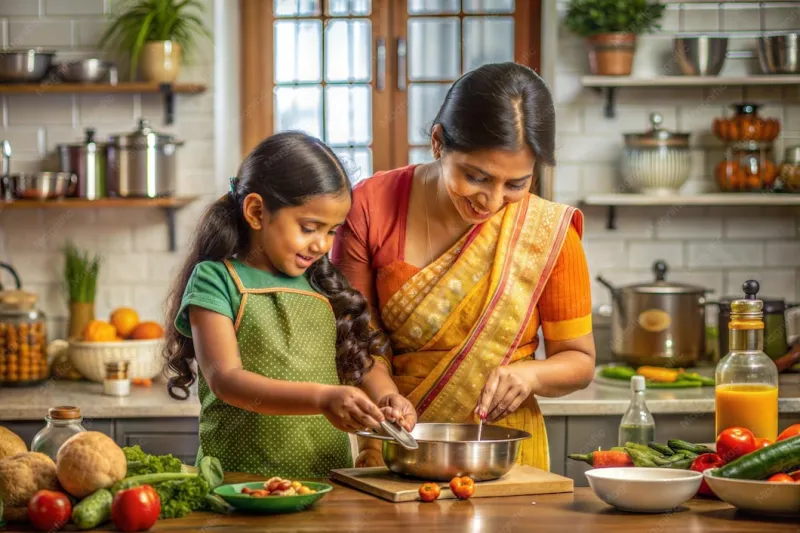
Photo: Indian Filipino mother daughter cooking together home kitchen warm diaspora, via img.freepik.com
Let's start with a smell. Maybe it's mustard seeds popping in hot oil, or garlic hitting a wok with coconut vinegar, or the low simmer of a pot of dal that's been going since noon. For millions of second-generation kids growing up in Indian and Filipino households across the US, that smell is memory. It's Saturday mornings. It's coming home from school. It's the particular comfort of knowing that however weird the outside world got, dinner was going to make sense.
But here's the thing nobody talks about enough: keeping that smell alive in an American kitchen is work. It's intentional, sometimes exhausting, occasionally hilarious work—and the women (and men, and grandparents, and aunties over FaceTime) doing that work deserve a lot more credit than they get.
The Grocery Store as Cultural Battlefield
Ask any Indian or Filipino mom in suburban America about the early years, and the grocery store story comes up fast.
Preeti Sharma, who moved from Jaipur to suburban New Jersey in the late 1990s, remembers driving forty minutes each way to the nearest Indian grocery store in Edison. "I would stock up like I was preparing for a siege," she laughs. "Hing, methi, the right kind of dal—you couldn't just grab these things at the ShopRite."
Maria Santos, who came from Cebu to Southern California in the early 2000s, had a similar experience. "I spent the first two years substituting everything. Banana blossoms from a Thai store. Fish sauce that was close but not quite right. My kids grew up thinking sinigang was supposed to taste a little different every time."
Both women describe a gradual shift—more Asian grocery stores, better online ordering, and eventually, access to specialty ingredients that made authentic cooking not just possible but practical. Today, platforms like IndiaPH Store exist precisely because that forty-minute drive shouldn't be the price of keeping your culture alive in the kitchen.
Teaching Kids Who Would Rather Have Pizza
Here's the honest part. Not every second-generation kid grows up begging their mom to teach them how to make biryani or kare-kare. Some of them go through a phase—sometimes a long one—where they'd genuinely prefer if their lunchbox looked like everyone else's.
Preeti's daughter Ananya, now 24 and living in Brooklyn, can laugh about it now. "I definitely had a period where I was embarrassed by the smell of curry on my clothes. I'm not proud of it." But she also remembers the moment things shifted. "I went to college and suddenly everyone thought Indian food was the coolest thing ever. And I was like—wait, I actually know how to make this. My mom taught me."
That's a story Filipino-American families tell too. The embarrassment, the shift, the reclamation. Jasmine Reyes, 28, grew up in Illinois and now runs a small food account dedicated to Filipino home cooking. "My mom never stopped cooking Filipino food, even when I complained. She just kept going. And now I'm the one calling her at 10pm asking how much bagoong goes in the binagoongan."
The through-line in both stories is the same: the mothers didn't negotiate. They kept cooking.
Fusion Isn't a Compromise—It's a Language
What's genuinely fascinating about diaspora kitchens in the 21st century is how naturally fusion happens—not as a trend or a chef's concept, but as a lived reality.
Kids who grow up eating adobo on Monday and butter chicken on Friday start to see flavor connections that their parents might not have noticed. The tang of tamarind in rasam and the tang of sinigang broth. The layered warmth of Indian garam masala and the aromatic depth of Filipino recado. The central role of rice in both cuisines—not as a side, but as the main event around which everything else orbits.
Some diaspora kids are turning these instincts into something creative. There are Filipino-Indian fusion recipes quietly circulating in diaspora food communities online—ube halwa, adobo-spiced chicken tikka, coconut milk kheer with pandan. These aren't restaurant gimmicks. They're the natural output of a generation that grew up with two flavor vocabularies and decided to use both.
For parents, this fusion can feel like a gift or a slight, depending on the day. "Sometimes I watch my son cook and I think, that's not how you make it," admits Maria. "But then I taste it and I think—okay, this is actually good. It's just his version."
The Rituals Matter More Than the Recipes
Food anthropologists will tell you that culinary transmission isn't really about recipes. It's about rituals—the act of cooking together, the stories told while chopping onions, the specific way a grandmother rolls dough or folds lumpia.
Preeti talks about making rotis with her daughter every Sunday morning as a ritual that had nothing to do with efficiency. "It took twice as long with her helping. But that's where she learned. Not from a recipe card—from standing next to me."
Maria describes the annual tradition of making lechon for family gatherings as the event her kids look forward to most. "It's a whole day. It's loud, it's messy, there's always an argument about something. But everyone's together. The food is almost secondary."
These rituals are the real inheritance. The recipe is just the excuse to gather.
What American Kids Are Teaching Their Parents
Here's a plot twist that diaspora parents don't always see coming: the cultural exchange runs both ways.
Ananya taught her mom how to make dal in an Instant Pot. Jasmine introduced her parents to Filipino cooking channels on YouTube that they now watch religiously. Second-generation kids are often the ones driving their parents to try other Asian cuisines, to experiment, to document family recipes before they're lost.
"My daughter set up a Google Doc with all my recipes," Preeti says, still a little amazed. "I never would have thought to do that. Now my mother-in-law in Jaipur is adding her versions."
That Google Doc—a living document connecting a kitchen in New Jersey to a household in Rajasthan—is maybe the most modern diaspora artifact imaginable. And somehow, it's exactly what home cooking looks like now.
Keep the Kitchen Connected
At IndiaPH Store, we believe that authentic ingredients are the foundation of authentic food memories. Whether you're hunting for the right hing for your dal tadka or the proper patis for your adobo, our Food & Ingredients collection is stocked with the real stuff—because your kids deserve to taste exactly what you remember.